

Author Name: Bobby Perry
Name of Publication: Rage and Hunger
Where to find it? Currently at Amazon.
Describe your work in 10 words or less for people who are just learning about it.
The zombie apocalypse told through a different and unique perspective.
Can you talk a bit about your path to publication for this work?
This story started as a single sheet of paper with a brief description of a zombie character I wanted to portray at a local haunted house. I played that character for 14 years, and still do. I always loved him and decided to breathe more life into the story and flesh him out more. That turned into this project. Over the course of the last nearly four years, I worked on the manuscript.
When I was nearly complete with the first draft, I joined the HWA and researched the Mentor Program. I was lucky enough to be paired with two amazing mentors who helped me refine the piece and opened my eyes to elements of the story I never thought about. They also gave me some insight into the publication process.
I decided that come Hell or high water I was going to publish the finished product and settled on self-publishing. Through research I found a company that works with Amazon, who completed edits, formatting, and ultimately the release of the book. It took nearly 7 months of edits, and constant work on the story before it was ready, but when I saw the first Author Proof copy, I was amazed and couldn’t believe I had given life to Meatbag’s story in a way that people outside my acting crew from the haunted house would know.
Describe your writing process. Do you outline, plot and plan, or is your writing more organic?
When I write, I work backwards. I knew what made Meatbag who he was, and I knew what the final scene in the story would be. I also knew what some of the pivotal moments in the story would be. I worked away knowing the ending and those keys points, and started trying to create a story that would tie these elements together in an organic and interesting way. When I hit a block where I couldn’t seem to get that connection between the new narrative and a particular scene or chapter I knew I wanted, I would start a new chapter and try to see if I could route the story down a new road that might make that connection.
Who was your favorite character in this work to write? Why?
Meatbag, hands down, no questions asked. My day job caused plenty of stress and tension in my life. When I created Meatbag, I wanted him to be the complete opposite of me. When I would act at the haunted house, I became a different person when the makeup and costume went on. This evil, vile, vindictive monster served as much needed stress relief and in many ways is my evil alter ego.
When I was writing the story and finally came to the point of introducing Meatbag, I was going through a very stressful, and dark time in my life. Writing him allowed me the opportunity to get that same catharsis as acting as him had. If I was having a bad day, I could pass that along to the character. That scene or chapter was more intense, or showed more of the reprehensible character that Meatbag was. It helped me to be able to move out of that darkness, and not allow it to envelop or overpower me.
Do you have a least favorite character? Anyone you ended up cutting from the story?
I did not cut any characters from the story. Every one of the named characters is modeled upon someone from my actual life. I withheld a couple for a sequel, and a couple short stories I am working on, but I did not cut anybody.
My least favorite character is not because I dislike the role they played or the way in which I wrote them. There are two characters that were very difficult for me to write.
The first one is Paul Elvis, an antagonist early on in the story. Paul was difficult because the person that I based that character off of is one that had a life changing impact on me, and not for the better. They are in this book purely because I have thought many times over the years of how much pain, anger, and grief they brought me. So, I used the character as a way to deal with those lingering hostilities.
The other is the main female protagonist, Lisa. She was difficult for me, because I had completed most of the narrative, and was going through a negative event I never anticipated in my life. I wanted to maintain the integrity of what the story was about, and not take out my frustrations or anger on this character. I spoke to my second HWA mentor about this, and expressed how concerned I was that I would wind up ruining the story because of the negative events in my life. He advised me to try writing something completely new. Something different, and deal with the traumas going on there, and after I could return to the story. In doing so, I maintained the integrity of the narrative, and have grown to be okay with the path Lisa took in her creation, but it was incredibly difficult to do, because parts of me wanted to kill her off early and introduce a different character into her role in the story.
Do you identify with your main character, or did you create a character that is your opposite?
This is a bit of a trick question. This book is written using a lot of inspiration from my own life. Many scenes in it are pulled directly from my life. As are all the named characters.
Both the main protagonist and antagonist are versions of myself. As such I absolutely identify with both. Rob represents the moral and emotional goodness of a guy that has had a bad hand dealt to him and is doing whatever he can to survive while also dealing with his own tragic history and traumas. Meatbag is a complete and opposite representation of me. He represents the person I feel I could become without a conscience, without that filter of knowing that something is or isn’t right. I call it my Looney Toons moments. You know that moment where you are talking to someone, but in your head you are looking for the nearest curb to throw them off of, only absent mindedly paying attention to the conversation at hand.
So yes, I would say I identify very closely with both main characters.
What was your favorite (or most difficult) chapter to write in this work? Why do you think that was?
My favorite chapter in the book is the sequence at the Walmart parking lot. I had envisioned it as a movie a thousand times while I was writing this. When I finally got to that portion of the manuscript, I sat up all night writing it in one session. It came to life so easily for me and is my favorite scene in the entire book. It is so visceral, and, while not based in true life, served as the turning point in the story both from the perspective of the narrative, but also as it pertained to the way in which the story would move forward being written.
The most difficult for me was absolutely the death of Rob’s mother Traci. My momma was my biggest supporter. She absolutely hated zombies and couldn’t quite understand my love for the haunted house industry nor how I could spend such a large amount of money on a Halloween mask. Despite this, and though she wasn’t a fan of Meatbag, she would have gotten a kick out of the fact I published a story about him. She passed away very randomly and suddenly. This event broke me, and left scars on my psyche that I am still dealing with to this day. When I wrote this chapter, I wanted to encapsulate the exact feelings I was having when it happened to me. It brought to the forefront many memories of that time I almost wish would have stayed buried. I think in the end though, I was able to capture that emotion, even though I’ll admit it is one of the chapter’s I may skip over during my reading.
What has been the toughest criticism you have received as an author? What has been the best compliment?
The toughest criticism I have received as a writer is how my attention to detail really paints a picture where the reader can feel they are there, but at times this also can bog the story down and be detrimental. This caused many reviews of different sections. One chapter features a law enforcement funeral. It was something I am very familiar with and knew exactly how I wanted to write it. During test reads, this chapter is one I received the most criticism for, and even my mentor tried to get me to reduce it. I resisted but did do some work to make it less dense with descriptors, and with more narrative.
This chapter though also resulted in my best compliment to date for my writing. My boss ordered a copy of the book right after I released it. He got it and started reading right away, moving very quickly.
One morning as I entered the office for work, my salutation from him was a robust two-word phrase, the first word began with “F” and I’ll let you imagine the rest of it. My boss is a very seasoned veteran of the field I work in, and he told me, after the shock of that interaction, he was reading that chapter, and by the time he was finished he felt he was there and was emotional about it. His wife even chided him a bit about it. This was the emotion I wanted in that chapter, and for him to tell me this, I knew I had made the right choice to leave that chapter as intact as it was in the finished manuscript.
What is your favorite line from your book?
My favorite line is at the end of chapter 16. It is the voice of Traci speaking to Rob and she says “… you’ll figure it out. I love you, baby.” The reason this is my favorite is because I have been in a position where I would do anything to hear momma’s voice again, if only for a brief second. During my darkest times in life, she would always tell me that, in those exact words. It is the only bit of my momma’s voice I can still remember and has helped me more times than I can count since her passing.
Is there anything you would like people to take away from your book?
I am not typically one of those hidden meaning kind of people. I say it like it is. There wasn’t an underlying message I set out to tell when I was writing this story. Knowing it so well though I would hope that if someone takes away anything from this it is not to take anything for granted. Life and everything in it are so precious, and it can end in the blink of an eye. Get the bigger popcorn at the theatre, talk to the cute guy or gal at the bar, tell those around you that you love them, don’t assume tomorrow will be there for you, or anybody else. It is not a given and it can be over in an instant. Ultimately though, I just hope that those that read my story will enjoy my take on the zombie apocalypse.
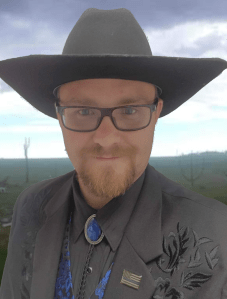
Bobby has long had a love and admiration for horror. In fact, it was a part of his life from his earliest memories with his family in Tucson. They were always hiding around corners and leaping out at each other, trying to get an easy and often hilarious jump scare on unsuspecting cousins or siblings. This love for horror was only furthered by the works of John Carpenter and Wes Craven. Bobby’s favorite horror character has always been Freddy Krueger, with the mannerisms and sadistic behavior he displayed towards his victims inspiring Bobby’s own characters in his haunted house career.
Bobby worked in two of the best-known and longest-running haunted houses in Colorado Springs: Mind Seizure and Ghoul’s Gulch, until each of them closed.
Bobby is a third-generation first responder, following in his father’s footsteps by working as a police officer in a small town in Colorado. He has always said that the horror genre, specifically writing or acting in it, has allowed him to release the day-to-day stresses of the job he loves.
He lives on 35 acres east of Colorado Springs with his two young sons, RJ and Essek, along with a variety of livestock, a cat, and three dogs. In his free time, Bobby runs a longstanding Dungeons and Dragons game for his family and co-workers, drawing inspiration from the horror properties he loves.
Although retired from haunted houses, Bobby says he and “Meatbag” would gladly return to scaring people if the opportunity presented itself. He jokes that the chainsaw he used to run around with may be replaced by a newspaper or a pocketful of Werther’s and a determined, yet casual stroll.
 HWA Colorado